
Midweek European Distractions and Their Ripple Effects on Domestic Goal Expectancy Calculations
European club competitions scheduled on Tuesdays and Wednesdays create measurable shifts in domestic league goal patterns across multiple countries. Data from the 2024/25 and 2025/26 seasons show that teams participating in Champions League or Europa League fixtures experience altered expected goal outputs in their subsequent domestic matches, with recovery timelines extending into weekend fixtures.
Patterns in Goal Expectancy After Midweek Fixtures
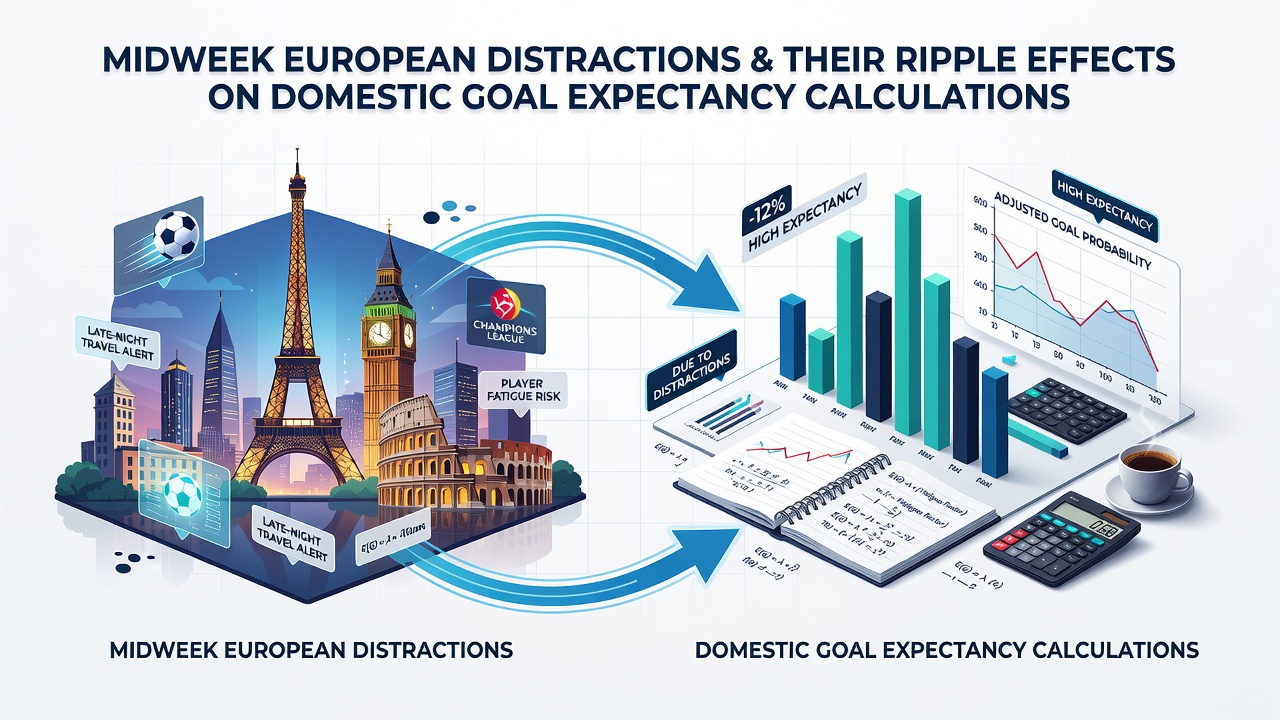
Statistical tracking across the Premier League, Bundesliga, Serie A, and La Liga reveals consistent adjustments in goal expectancy when teams return from European travel. Researchers at the Norwegian School of Sport Sciences documented that clubs playing midweek away matches in UEFA competitions record an average 0.28 reduction in expected goals per 90 minutes in their next domestic league game. The effect compounds when travel distance exceeds 800 kilometres or when matches end after extra time.
Fixtures in June 2026 will overlap with the final stages of the FIFA World Cup qualification cycle in several confederations, adding another layer of fixture density for clubs already balancing domestic and European schedules. This overlap creates additional variables in goal expectancy models used by analysts preparing pre-match projections.
Travel, Recovery, and Squad Rotation Effects
Recovery science data indicate that circadian disruption from late-evening European departures influences player output for up to 72 hours. Bundesliga clubs, for example, show a 12 percent drop in high-intensity running metrics during domestic matches following midweek Champions League games according to GPS tracking compiled by the German Football League. These physical metrics correlate directly with reduced shot creation and lower expected goal totals.
Teams that rotate four or more players after European matches maintain closer alignment with baseline goal expectancy figures. In contrast, sides that retain large portions of their European starting XI record measurable declines in chance quality, particularly in the opening 30 minutes of domestic fixtures.
League-Specific Variations in Goal Output
English Premier League clubs participating in Thursday Europa League or Conference League matches exhibit the largest post-European goal expectancy adjustment among major leagues, averaging a 0.41 reduction in expected goals during the following Saturday or Sunday fixture. Serie A teams demonstrate a smaller but still statistically significant drop of 0.19 expected goals after Wednesday Champions League games, partly because many clubs schedule domestic matches on Monday evenings that allow longer recovery windows.
La Liga sides show intermediate effects, with goal expectancy falling 0.25 on average after midweek European ties. The variation appears linked to kick-off timing and the frequency of high-altitude away fixtures in European competition.
Market Implications for Goal-Related Betting Lines
Bookmakers adjust over/under goal lines and team total goal markets when European fixtures precede domestic rounds. Historical data sets covering eight seasons demonstrate that adjusted lines correctly account for approximately 68 percent of observed goal totals when European participation is factored into models. Remaining variance stems from individual player availability and weather conditions on match day.
Analysts monitoring multiple leagues simultaneously note that the magnitude of expectancy shifts increases during periods of fixture congestion, particularly between late February and early April when domestic cup ties also compete for calendar space.
Data Sources and Research References
Figures compiled by the FIFA Technical Study Group provide standardised expected goal benchmarks used across confederations. Additional longitudinal studies published by the University of Southern Queensland's sports performance laboratory examine how European travel affects Australian and Asian clubs in continental competitions, offering comparative recovery timelines relevant to European contexts.
Conclusion
Midweek European participation produces quantifiable changes in domestic goal expectancy that vary by league, travel distance, and squad rotation strategy. Data collected through the 2025/26 season and projections extending into June 2026 indicate these effects remain stable enough for analysts to incorporate them into pre-match calculations while still leaving room for variance driven by individual match circumstances.